

How to Find Your Fragrance Type: A Complete Scent Guide
With hundreds of candle, perfume, and home fragrance options available, figuring out what you actually like can feel overwhelming. The truth is, scent preference is deeply personal, but it is not random. By understanding fragrance families, learning how notes work together, and testing scents intentionally, you can build a fragrance profile that feels unmistakably you. This guide walks you through every step, from the science of the fragrance wheel to practical tips you can use the next time you shop for soy wax candles or eau de parfum.
What Are Fragrance Families?
A fragrance family is a category that groups scents sharing similar dominant characteristics. Think of it like music genres: once you know you love jazz, you can explore sub-genres with confidence. The same logic applies to scent.
According to the widely used classification system refined by fragrance expert Michael Edwards, there are four primary fragrance families: floral, oriental (amber), woody, and fresh. Each family branches into subfamilies that add nuance and variety.
| Fragrance Family | Key Characteristics | Common Notes | Ruby + Begonia Example |
|---|---|---|---|
| Floral | Sweet, romantic, powdery | Rose, jasmine, peony | Desert Blooms |
| Fresh | Clean, zesty, bright | Citrus, green herbs, aquatic | Rainstorm, Cheers |
| Woody/Earthy | Warm, grounding, rich | Sandalwood, cedar, vetiver | Sage + Timber |
| Sweet/Gourmand | Edible, cozy, indulgent | Vanilla, caramel, honey | Candy Crush |
| Exotic | Rich, sensual, spiced | Amber, musk, patchouli | Warm + Cozy |
The Fragrance Wheel Explained
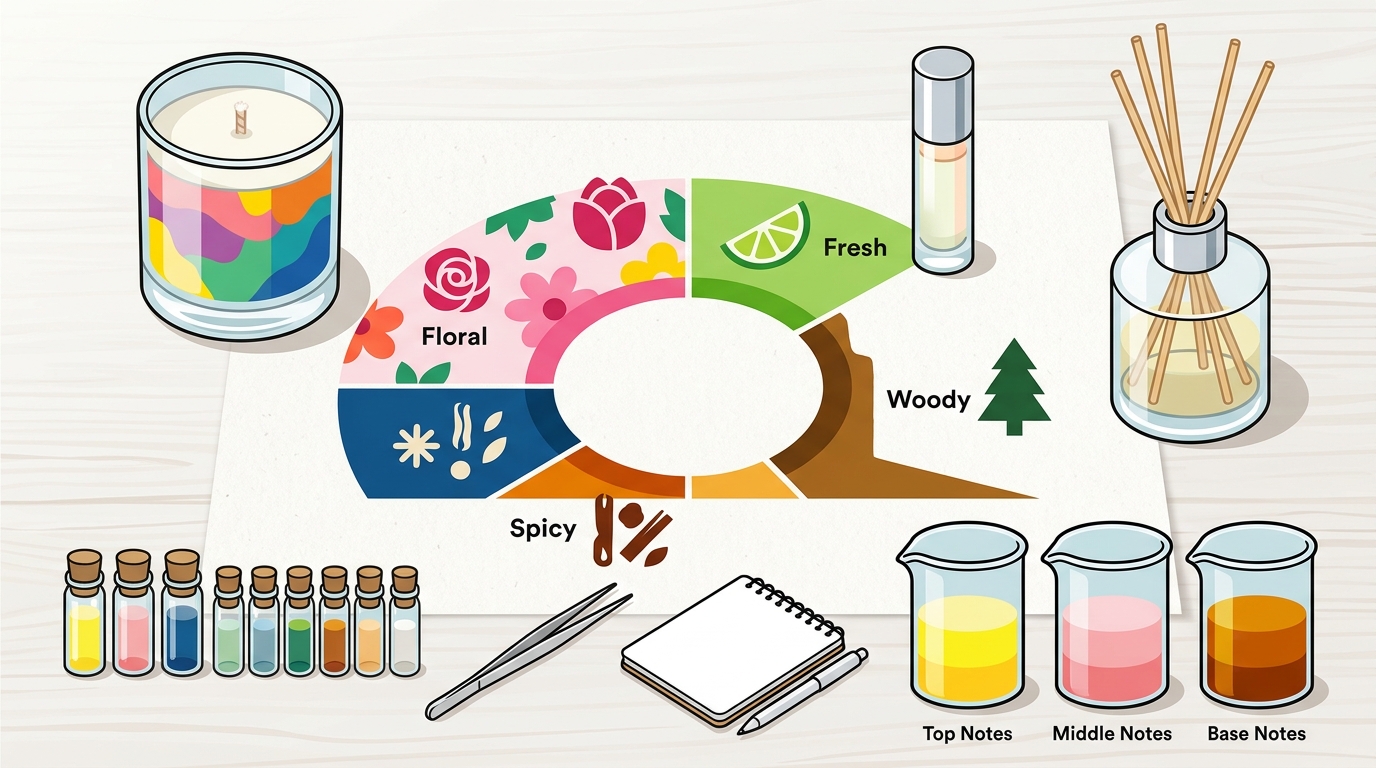
The fragrance wheel is a circular diagram that maps how scent families relate to one another. It was originally inspired by perfumer Paul Jellinek's 1949 Odor Effects Diagram and later refined by Michael Edwards into the tool we use today.
Families positioned next to each other on the wheel share similar traits, making them easy to blend. Families on opposite sides create bold, contrasting combinations. For example, if you love fresh citrus scents, the wheel suggests you may also enjoy neighboring floral or green notes.
How to Use It
Start by identifying a scent you already love. Find its family on the wheel, then explore the adjacent families for new favorites. This approach turns random browsing into focused discovery.
Understanding Top, Middle, and Base Notes
A fragrance note is an individual scent component that contributes to a fragrance's overall profile. Every well-crafted scent is built in layers, often visualized as a pyramid.
The Three Layers
Top notes are what you smell first. They are light, volatile molecules like citrus and herbs that fade within 15 to 30 minutes. Middle notes (also called heart notes) emerge as the top notes fade and form the core character of the scent. Base notes are the deep, long-lasting foundation, including ingredients like sandalwood, vanilla, and musk, that can linger for hours.
When you pick up a Ruby + Begonia room and linen spray and sniff it straight from the bottle, you are mostly smelling top notes. Give any fragrance at least 10 minutes on skin or fabric before judging it.
How to Identify Your Scent Preferences
Finding your fragrance type does not require expensive equipment. It requires intention and a simple process.
Step 1: Audit What You Already Own
Gather every scented product you love, from candles and perfumes to lotions and laundry detergent. Look for recurring themes. Do most of them lean citrusy and clean? Warm and vanilla-heavy? Earthy and herbal? That pattern is your baseline.
Step 2: Test Deliberately
When sampling new scents, limit yourself to two or three at a time. Apply to pulse points or test strips and let each one develop for at least 20 minutes. Rushing leads to "nose fatigue," where everything starts smelling the same.
Step 3: Keep a Scent Journal
Write down what you tested, what you liked, and why. Over time, patterns will emerge that point you squarely toward one or two fragrance families.
Matching Fragrance to Mood and Season
Your environment and emotional state play a significant role in which scents appeal to you. Lighter, citrus-forward fragrances tend to feel effortless in spring and summer, while richer woody and amber scents bring cozy sophistication to cooler months.
Mood matters, too. Energizing citrus or herbal blends work well for productive mornings. Calming lavender or warm vanilla is ideal for winding down at night. You do not have to pick just one signature scent. Many people rotate fragrances the same way they rotate wardrobes.
Home Fragrance vs. Body Fragrance: What Changes?
A home fragrance is a scent designed to fill and enhance a living space, delivered through products like candles, diffusers, or room sprays. A body fragrance is a scent formulated to wear on the skin, such as perfume, lotion, or body wash.
The fragrance families are the same, but how you experience them differs. Home scents interact with room size, airflow, and temperature. Body scents react with your skin chemistry, which is why the same perfume can smell different on two people. At Ruby + Begonia, many signature scents are available across both categories, so you can layer your favorite fragrance from your diffuser oil all the way to your whipped body frosting.
Key Takeaways
- Fragrance families (floral, fresh, woody, sweet, exotic) are the foundation for understanding your scent preferences.
- The fragrance wheel maps relationships between scent families and guides you toward new options you are likely to enjoy.
- Every fragrance has three note layers: top, middle, and base. Give a scent time to develop before deciding.
- Audit your current collection to spot patterns in what you already love.
- Test only two or three scents at a time and keep a journal of your reactions.
- Match scents to mood and season for maximum enjoyment.
- Layering the same fragrance across home and body products creates a cohesive, intentional scent experience.
Frequently Asked Questions
What are the main fragrance families?
The four primary fragrance families are floral, oriental (amber), woody, and fresh. Many brands, including Ruby + Begonia, also highlight subfamilies like sweet/gourmand and exotic to help shoppers navigate more easily.
How do I know which fragrance family I prefer?
Start by looking at the scented products you already own and love. Identify common notes (citrus, vanilla, floral, earthy) and match them to a fragrance family. Then test new scents within that family to confirm your preference.
Why does a fragrance smell different on me than on someone else?
Body chemistry, including skin pH, hydration levels, and natural oils, interacts with fragrance molecules and alters how a scent develops. This is why testing on your own skin is more reliable than smelling from a bottle.
Can I like more than one fragrance family?
Absolutely. Many people are drawn to two or three families. You might prefer fresh scents for daytime and warm, gourmand scents for evenings. There is no rule that limits you to a single family.
What is the best way to sample fragrances without buying full-size products?
Look for discovery kits, sample sets, or smaller format products. Ruby + Begonia offers items like car fresheners and soy wax melts that let you experience a scent affordably before committing to larger purchases.
Do fragrance preferences change over time?
Yes. Hormonal changes, age, climate shifts, and even dietary habits can influence how you perceive and enjoy scents. Revisiting your preferences annually is a good practice.
What is the difference between home fragrance and perfume?
Home fragrances are formulated for room diffusion and typically use soy wax, reed diffuser bases, or aerosol carriers. Perfumes are formulated with alcohol or oil bases designed to interact with skin chemistry and last on the body.
How many scents should I test at one time?
Limit yourself to two or three. Your olfactory system fatigues quickly, and testing too many scents at once leads to inaccurate impressions. Smelling coffee beans between tests can help reset your nose.
Find Your Signature Scent at Ruby + Begonia
Ready to put this guide into action? Browse our fragrance collections organized by scent family, including Floral, Fresh, Exotic, Masculine/Earthy, and Sweet. Every product is hand-poured, non-toxic, and made with love at our shop in Mount Pleasant, TX. Visit myrubyandbegonia.com or stop by 207 N Madison Ave to smell the difference for yourself.